👋 I'm Bella. By day I'm a freelance marketer. By night, early morning, and weekend, I am working on a niche website and writing a novel. 💌 This newsletter is a celebration of juggling multiple creative pursuits at once. Subscribe for time-maximizing tips, the highs and lows of running a small business, and a behind-the-scenes look at the various projects I'm working on (and why).
Share
Why I hate to-do lists
Published about 2 years ago • 4 min read
It didn’t always used to be this way. Once upon a time, I loved to-do lists.
I also loved pretty notebooks (still do) and particular kinds of biro (that too) and running a thick line through a finished task. Well, that one—that last point—I don’t really love doing that anymore because now I know the truth.
It took me a while to get there, though. Years, in fact. Years to realise that to-do lists are not, in fact, the productivity-enhancing tools I once thought they were.
What they are is guilt-tripping, self-sabotaging, analog little monsters 👿
Here’s why.
To-do lists never end
Show me a person with a completed to-do list and I’ll…
well, I’ll be very very surprised.
These things are impossible to complete because it’s 2024 and because (here in the UK at least) the retirement age is soon to be 101* and because we’re constantly distracted and because we’ve got to post on Instagram and then Substack and then read our emails and quickly empty our phone’s overloaded storage and then respond to the group Whatsapp message and remember to send an invoice and we haven’t even got to the actual work yet.
*they’re talking about 71, but still. It’s a lot.
Suffice to say the to-do list will truly never end. It cannot.
You always feel guilty
As a result, to-do lists only ever get longer. Just as soon as you’ve crossed off two items from the top, you’ve added another three to the bottom.
Then somehow it’s 4 p.m. and you’re meant to be finishing work in a couple of hours and there’s no way you’ll get through everything by then.
So, the to-do list you made on Monday rolls over onto Tuesday, then Wednesday, and on and on it goes until one day in a fit of rage you grab hold of the weeks-old worn-out scrap of paper that governs your life and tear it into tiny little pieces and start afresh.
You will not be made to feel guilty by a bulleted list that’s long overstayed its welcome.
You will begin again with a new to-do list. A new set of priorities.
And so the cycle continues.
Cathryn Lavery via Unsplash
Here’s what I do instead
I’m not sure exactly when or where I heard the term ‘Parkinson’s Law’ or ‘timeboxing’ (probably around the time I read Cal Newport’s ‘Deep Work’), but these two concepts changed the way I think about time.
Parkinson’s Law is the idea that work expands to fill the time given to complete it. For me (in the old days), that meant working on task #1 on the to-do list until I was finished. And because there was no defined cut-off point by which to finish, that task could last anywhere between 15 minutes and two hours… or three days.
So at last I had a name for my issue with to-do lists: Parkinson’s Law.
But what was the solution to this problem?
Guardrails.
Or—in productivity speak—timeboxing.
What the eff is timeboxing?
Really, it’s just a w*nky way of saying ‘allocate specific chunks of time to specific tasks.’
Depending on the kind of work you do, these boxes of time might be item-specific (e.g. 30 minutes to write a proposal to X) or they might be a little broader (e.g. 2 hours for ‘Substack’).
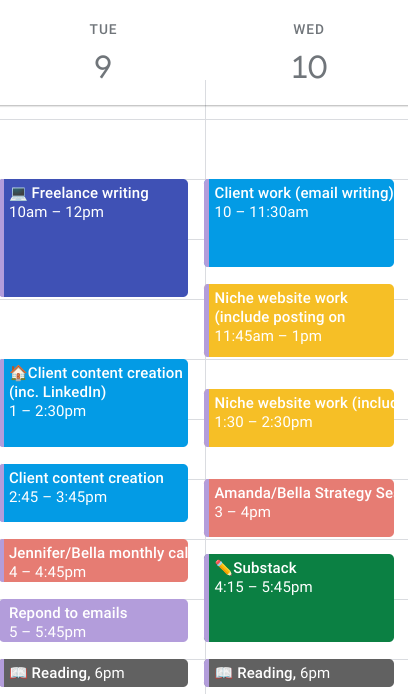
Rather than working through a paper to-do list in chronological order, you figure out what you need to accomplish that day/week and from there, add tasks (‘events’) to your calendar. The duration of these tasks is up to you to decide.
But remember—it’s important to set limits on how long you’ll work on any one activity because your focus will naturally diminish over time**.
If you know that writing your weekly newsletter takes you about 4 hours, break this up into 2x 2-hour or 4x 1-hour chunks of time (or whatever chunk of time suits your ability to concentrate best). You’ll be able to accomplish a lot more, a lot faster that way. Especially if you get rid of all distractions (phone, open inbox tab, etc).
**The range for most people to be able to stay focused is between 10 and 52 minutes, studies have found.
A snapshot of my timeboxed calendar from last month
So, I never ever touch pen + paper?
While to-do lists and I will never be the best of friends we once were, I haven’t sworn off them completely.
I usually start with pen and paper to list out my priorities for the week. Then I allocate them to my calendar (see above) and then, as I go through my day, I’ll jot down anything ‘unplanned’ that comes up. New emails I need to reply to. Invoices I have to chase. Ideas for clients I’d like to suggest.
If they’re small tasks, they might stay written down in the physical diary I keep beside me as I work to complete later/tomorrow. If they require more time or mental energy, I allocate them a slot in my Google calendar.
So yes, I do still use to-do lists ish. But they no longer run my days.
What do you do?
This way of planning time isn’t for everyone. Some people prefer more fluidity, others need an impending deadline to do their best work.
If you choose to Unsubscribe, you'll be removed from all mailings. If you want to opt out of a particular series and don't see a link above to do so, just hit reply and let me know. I'll take care of it for you personally. | Update your profile | Tower House, Southampton Street, London, London WC2E 7HA
Making Time by Bella Foxwell
I'll inspire you to carve out time to (finally!) start your passion project.
👋 I'm Bella. By day I'm a freelance marketer. By night, early morning, and weekend, I am working on a niche website and writing a novel. 💌 This newsletter is a celebration of juggling multiple creative pursuits at once. Subscribe for time-maximizing tips, the highs and lows of running a small business, and a behind-the-scenes look at the various projects I'm working on (and why).
Welcome! Before you dive into this week’s newsletter, a few quick reminders: ⚡️ For business owners, did you know I offer 1:1 marketing sessions covering Instagram/LinkedIn/email? Find out more and book here. ✨ This month, I’m running ‘How To Master LinkedIn’, an online 2-part workshop with the British Institute of Interior Design. ✨ Client spotlight: I’ve been working with UN Women UK over the past few months, managing their Instagram and LinkedIn accounts. It’s been a privilege working on...
Ok, I’ll admit it. Every few weeks for the last few months I’ve had a small-scale freak out about AI and the future of my job/life/humanity as we know it. I’m sure you feel it too. The inability to move for scaremonger-y headlines and think-pieces about how ultimately we’re all doomed. What was it that the ‘Godfather of AI’ Geoffrey Hinton said? We should all become plumbers. Because a job like that — one requiring manual labour — is a safe bet as AI is increasingly able to handle much of the...
A couple of weeks ago, I attended a networking event aimed at connecting luxury travel agents with people that work in marketing, events, and PR. It was a great afternoon during which I talked a lot about the pros and cons of Instagram vs. LinkedIn, and why—when you have limited time and budget, as many of these new agents and young companies do—LinkedIn is the best place to be. Here’s why ↓ 1. It’s far less saturated To be honest, all my following points spawn from this one major truth:...